By Leigh Anne Hulva, BSN, RN— Women’s Health Educator
Working from home with adult ADHD can sound ideal, but losing the structure of an office can make focus, time management, and getting started unexpectedly difficult. Learn why remote work can challenge adults with ADHD and what practical strategies can help rebuild the structure your workday needs.
Working from Home with ADHD: Meet Jess*
For over six years, Jess sat in her cubicle in an open-plan office and dreamed of working from home. The office was loud and fluorescent and full of interruptions— an ADHD nightmare. She spent a significant portion of her time managing the sensory environment rather than actually working in it. She dreamed of a life without commuting or a dress code, with nobody stopping by her desk to ask her about the Peterson account when she was finally, finally in a state of focus.
When the pandemic sent everyone home in 2020, Jess got what she’d been dreaming of. She has been working from home ever since, and she would like to report that it is everything she hoped it would be.
It is, however, not everything she hoped it would be.
In many ways, it’s harder than the open-plan office she had escaped. The office, it turns out, had been doing a great deal of invisible work on her behalf. The fixed start time got her out of bed. The commute created a vital transition between home-brain and work-brain. The presence of colleagues was a source of constant body doubling. Just being “at work” created a sense of social accountability that kept her at her desk and (mostly) on task. The meeting schedule imposed a structure that her own brain, left to its own devices, does not reliably generate.
Without any of that, Jess feels at a loss, adrift at sea. Yes, there’s freedom. Oh, the freedom! The freedom to eat lunch at 4 pm every day this week, when hunger finally yells loudly enough to get heard, and then silenced with a donut and half an apple. The freedom to not change out of her pajamas since Tuesday, which was embarrassing when she had a package delivered midday on Thursday. The freedom to check a notification on her phone and then look up to find three hours have evaporated.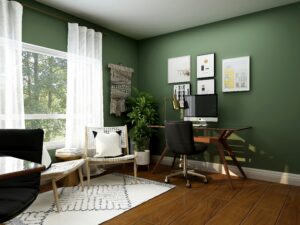
It turns out, this kind of freedom isn’t working that well for her. With an ADHD diagnosis under her belt, she needs to figure out how to work within some boundaries. But without an actual workplace, she first needs to figure out what those boundaries should be and how to build them.
[*Case studies are fictionalized composites of the real experiences of women, drawn from both personal and professional encounters with women navigating ADHD.]
Why Working From Home is Hard with ADHD
Working from home tends to sound appealing for all the reasons it sounded appealing to Jess: no commute, no dress code, no strict schedule, no annoying colleagues who refuse to use earbuds when they listen to music, no noisy office and tiny breakroom with its sticky table. And flexibility is always good… right?
This optimistic view isn’t wrong, exactly, but it ignores what a lot of people— and especially people with ADHD— require in terms of structure. Poor executive function makes it difficult to generate structure. The ADHD brain tends to borrow structure from its environment… from deadlines, from social accountability, from the presence of other people working nearby, from the invisible scaffolding that a workplace rhythm provides. Remove that external structure, and the ADHD brain doesn’t tend to just compensate by recreating it internally. Instead, it tends to simply operate without the structure. The chaos this created led to Jess’s 4pm pajama-clad donut lunches.
The Specific Challenges of Working From Home With ADHD
No External Time Structure
A fixed start time, a regular commute, a lunch break. These are all external time structures that impose rhythm on a workday. They don’t require the individual worker to generate that rhythm internally. For neurotypical workers, this might not be necessary to get the job done. For someone with ADHD, someone for whom time blindness is a recognized feature, the loss of this structure removes the scaffolding that was helping compensate for an unreliable internal clock.
Without the external structure of the workplace, a weekday becomes a nebulous expanse of hours in which 9 am and 2 pm feel indistinguishable. An hour or three can disappear down a Wikipedia rabbit hole, and the checking of a single notification in the morning can lead to the realization that “now it’s somehow the afternoon.”
The Loss of Social Accountability
Working in the presence of other people— even people who are not watching or actively interacting with you— provides a gentle form of social accountability that helps support focus and task initiation for many people with ADHD. This is the body-doubling effect we discussed in a previous productivity article. For workers who relied on this in an office environment (even when they didn’t know they were doing it), its absence at home can lead to a confusing drop in productivity. This might be mistaken as a personal failure rather than what it actually is: the loss of an external support.
Your Home Is Full of Distractions
Your home contains, in all probability, an incredible cornucopia of things that are far more interesting than work. Even the laundry that needs folding might seem more appealing than starting on that report for Fred in Accounting. There’s also the book on the nightstand, the kitchen (just nine steps away) full of tiny dopamine hits anytime the mood strikes, a really comfy sofa that sits right in front of the TV, and a pet that probably wants to be played with.
For the ADHD brain, which tends to be drawn toward immediate interest and away from low-reward tasks, the home environment is actively competing with work for attention. And the home field has several advantages: it’s familiar, it’s comfortable, and it’s full of readily available distractions.
The Blurring of Work and Home
A physical commute to and from work might seem like nothing more or less than a nuisance. For the ADHD brain, however, it can create a valuable mental transition time between home mode and work mode (and back again). When the bedroom becomes the office, but Netflix lives there too, focusing on work can be that much harder. With no clear boundaries between workdays and home life, home life bleeds into what should be working hours, and the workday seems to have no real end either.
Too Much Flexibility
Flexibility is something of a double-edged sword for someone with ADHD. The flexibility to set your own priorities means you have to do so. And then follow through. You have to make countless decisions, big and small, about when, how, and in what order to do things, without the external prompts that used to make them for you.
Decision fatigue is real, and the ADHD brain— which already uses more executive resources than a neurotypical one to accomplish tasks— might hit this daily decision-making limit earlier than expected. The result is a kind of executive function collapse that can look like laziness from the outside and feel like hitting a brick wall from the inside.
What Actually Helps ADHD When Working from Home
The Non-Negotiable Start Time
The single most helpful intervention for many people working from home has been a fixed, non-negotiable start time. This start time is treated with the same seriousness as a commute or an office arrival time. It means getting up, getting dressed, and being at the workspace by a specific time.
The getting dressed part matters more than you might think: The physical act of changing out of pajamas creates a behavioral cue for the brain that the day has started. Work is happening. Jess’s 8:30 alarm is labeled “you are a person who wears clothes.” It helps more than she thought it would.
Externalize the Day’s Structure
Having a visual plan for the day in plain view at your workspace can provide external structure. This can be a specific plan for each day, written down the night before, or a schedule that works for every day of the week. Time-blocking (where tasks are assigned specific time slots rather than simply listed) tends to be more effective for ADHD than a vague to-do list.
The plan doesn’t need to be followed perfectly. It just needs to exist, in plain sight, to take the place of meetings and schedules that you would have had at an office job. It needs to be there to remind you that the day has shape.
Designate Your Workspace
Ideally, you have a designated workspace in your home. Working from the same location consistently is a valuable signal to your brain that supports the work mental state. This works in the same way that being in a gym means it’s time to exercise. Plopping down wherever looks most comfortable in the moment can make you more easily distracted. Even if all you have is a corner of a room, set up there and make that the place your brain recognizes as the place it goes to work.
Build in Artificial Transitions
The commute to work used to be the transition that signaled the workday was about to begin. Without it, you’ll need something else. This could be a walk around the block, a certain playlist you only use at this time of day, or coffee just the way you like it.
The same principle can apply to the end of the workday. Having a closing ritual to signal to your brain that it has clocked out of work and back into home life can be helpful. This helps avoid the blurring of work into the evening that so many remote workers experience.
Recreate Social Accountability
One of the great benefits of working in an office is the simple presence of other people. Body doubling is a technique that many people with ADHD find effective. Simply working in the presence of another person can create effective support. This can be recreated for remote workers: co-working cafes, library work sessions, video calls with friends or colleagues who are also working; even online groups have formed for just this purpose. Jess joins a virtual co-working room online several mornings a week. This is a video call with strangers, all silently working at their own computers. She doesn’t even interact with them, but she recognizes that it makes a difference.
ADHD Work-From- Home Strategies
- Fix a start time and stick to it (fully dressed!)
- Write out and display a daily plan in full view
- Designate a dedicated workspace and keep it tidy
- Mark the start and end of the workday (as well as breaks or meals)
- Use virtual body doubling (such as a friend on video call), or try coworking spaces
- Use timers for tasks
- Take regular, scheduled breaks, pre-determined with timers set
Conclusion
Jess gets dressed every morning now, thanks to her “you are a person who wears clothes” alarm. She’s aware that this is a low bar and she’s okay with that. What works, works. She joins her virtual co-working room several days per week and keeps an eye on her schedule, which she has written on a whiteboard hung up just behind her laptop. She uses alarms to signal the start and end of her lunch break, and another to tell her that the workday has ended. It’s not a perfect system, but it works more often than not, and she hasn’t had to answer the door in her pajamas in months.
You can be diagnosed with ADHD and seek treatment for it at any point; it’s never too late. If ADHD is holding you back, now is the time to find a healthcare provider with experience treating adults with ADHD. If this article resonates with you, consider talking to your doctor about potential treatments. Find a provider who helps you figure out how to move forward into your best life! If you live in Nashville, and are seeking a consultation on Adult Adhd in Nashville, please reach out.
Frequently Asked Questions (FAQs)
Why is working from home so hard with ADHD?
Working from home removes the external structure that the ADHD brain relies on: the fixed start and end times, the commutes that create work-home transitions, the social accountability of having colleagues working nearby. Without these cues, the ADHD brain has trouble creating its own structure. The solution isn’t to simply try harder, but rather to deliberately recreate external structures in the home/work environment.
How can I be more productive working from home with ADHD?
The most effective strategies to increase productivity tend to focus on externalizing structure. This looks like having a non-negotiable fixed start time, a designated workspace, a daily plan written out and visible, and virtual body doubling. Timers for specific tasks (as well as lunch breaks and end-of-workday timers) can help prevent time blindness that can turn a five-minute notification check into an hours-long dive down a Wikipedia rabbit hole.
What is body doubling and how does it help with remote work?
Body doubling simply refers to working in the presence of another person (or people). It is a technique that is often effective at keeping people with ADHD more consistently on task. In a remote work context, this can be recreated through virtual co-working sessions, video calls with a friend or colleague who is also working, co-working cafes, or virtual body doubling online communities. The social presence doesn’t need to be interactive to be effective. Simply not being alone while working produces a meaningful difference for many people with ADHD.
Author’s Bio
I’m Leigh Anne Hulva, BSN, RN- a registered nurse, women’s health educator, mother of teenage daughters, and passionate advocate for women navigating perimenopause and menopause. I recently completed the Harvard Medical School course on Women’s Health, and in these pages I relish sharing what I learned there alongside what I know from lived experience. I bring to this work not only my training, but also the personal experience of navigating the very transition I write about. It is my privilege to share both, because this work is personal to me. I hope it feels that way to you, too.
I have been on the other side of this conversation, and I understand how much it matters to feel truly heard. At Nashville Concierge Medicines, my work is supervised by Dr. William Conway, MD, and I work directly under his licensure as a nurse educator.
About Leigh Anne Hulva by William Conway, M.D
Leigh Ann is an exceptionally gifted writer in the tradition of American Humanism. To fully learn from Leigh Ann, it is best to read all of her blogs. In her extensive portfolio, Leigh Ann moves past the rather dry medical literature to capture the lived experience of living with both ADHD and perimenopause. Leigh Ann captures the complicated, subtle ways that ADHD can dominate life and make life much more difficult
All of Leigh Ann’s case studies capture the lived reality of life with ADHD. None of the case studies are drawn from an actual patient.
A